The Mandala
Nature and the mandala, as cosmic pattern, personal compass, and metaphorical use
What Is the Mandala?
A mandala can simply be described as a pattern organized around a center.
Across cultures, mandalas appear as circular diagrams representing the cosmos, the
psyche, and the structure of reality itself.
But the mandala is more than symbolism.
It is a way of understanding how wholeness functions.
The Psychological Perspective
Psychologist Carl Jung observed that mandalas appear spontaneously in dreams and art
during times of crisis. He concluded that the mandala represents the Self — the
organizing totality of the psyche.
When we feel fragmented, the psyche generates circular imagery to restore balance.
The mandala functions as a self-correcting structure.
The Evolutionary Perspective
Thinker Terence McKenna suggested that modern civilization has displaced its center.
Instead of organizing around nature and lived experience, we organize around
abstraction.
He proposed that history is accelerating toward increasing novelty — a transformational
threshold.
From this perspective, the instability of our era may signal the collapse of a false
center.
Nature at the Center
Mandala Machine proposes that nature is the true center of the mandala.
Not nature as scenery — but as living intelligence.
When culture aligns with natural pattern:
- Technology becomes ecological
- Language becomes poetic
- Systems become regenerative
When culture detaches from that center:
- Acceleration becomes destabilizing
- Fragmentation increases
- Meaning thins
Why It Matters
The mandala is not mere ornamental spirituality. It is a structural
principle:
- In psyche, in ecosystems, in galaxies, in design
To restore the center is to restore coherence.
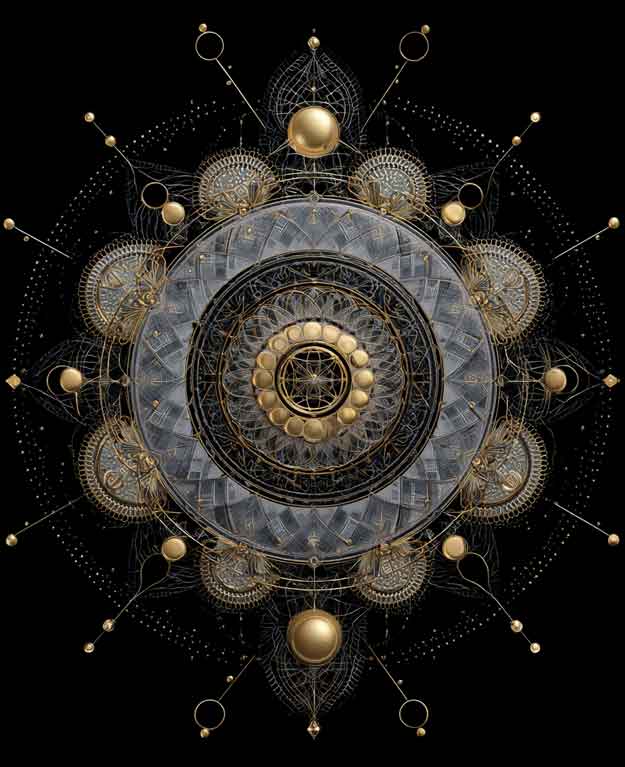
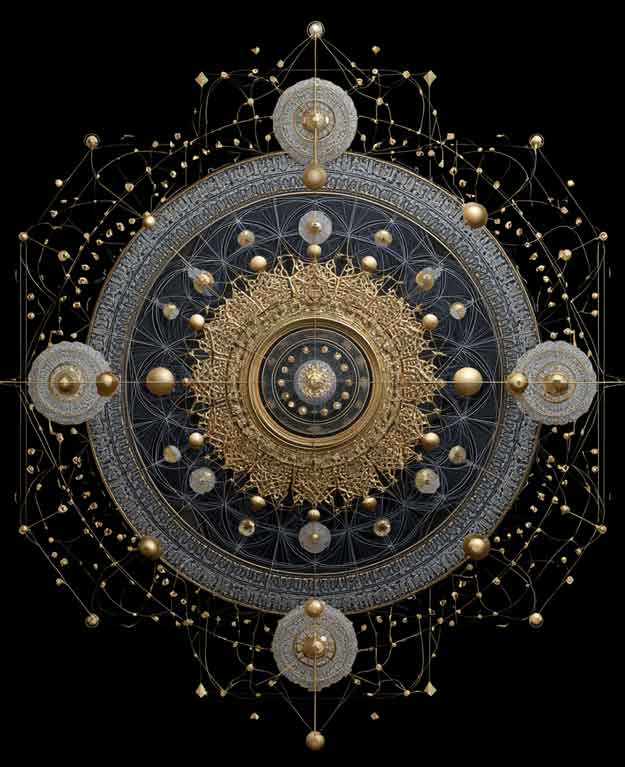
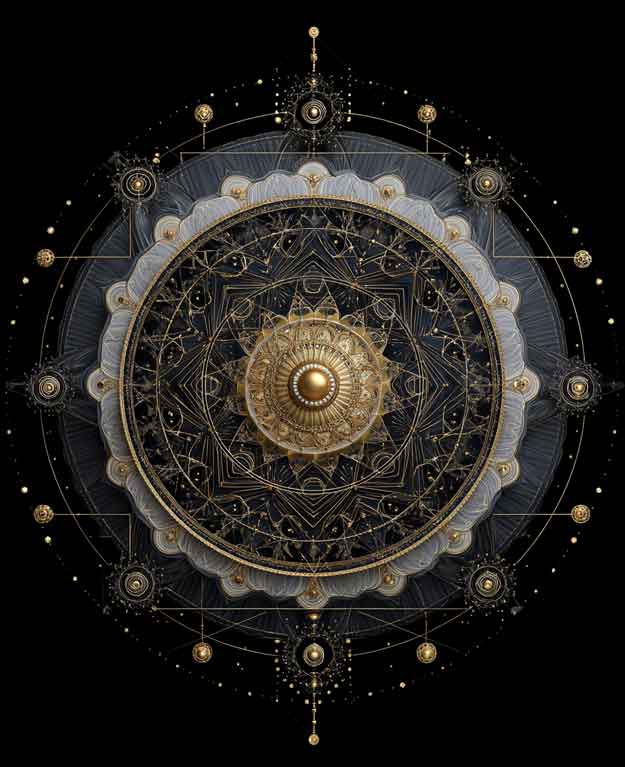
Mandala Machine creates visual meditations rooted in this principle — artifacts that
reflect living pattern rather than impose artificial order.
What Is the Mandala, Expanded - Nature and Psyche as Mandala
The word “mandala” traditionally refers to a circular, often symmetrical diagram or map used in spiritual practices as a symbol of wholeness, unity, and the cosmos. In such spiritual contexts, a mandala often represents the structure of reality — from the individual mind to the universal, a correspondence between inner psyche and outer reality.
The mandala here, rather than solely a literal drawing or a ritual object, is also a metaphor for the organizing pattern around which the world, and human meaning coheres. This view sees the mandala as a symbolic image, not of static religion or art, but of a living cosmology in which Nature is the organizing principle. It's the idea that meaning, psyche, and reality are concentric around nature rather than around abstract constructs like ideology.
Philosopher and ethnobotanist Terence McKenna suggested that Nature is the Center of the Mandala. Nature, including the living, dynamic world around us, can be understood as the central organizing pattern of reality, culture, and human consciousness. He argued that modern society has lost touch with nature, replacing direct lived experience with abstract language, mechanistic science, and cultural constructs that obscure the richness of the world. Even if useful, when they displace direct experience of nature, they sever the mandala from its center.
He suggested that with nature displaced from a central role, nature as psyche had been occluded by culture, our sense of existence flattened under infrastructures and mythologies, and that historical, cultural, technological, and scientific paradigms are shaped by this distortion. For him the universe was patterned, aesthetic, and participatory, and a future post-historical state — one beyond purely mechanistic materialism and ideological conflict — will emerge when we see ourselves as part of nature rather than separate from it.
Swiss psychologist Carl Jung understood the mandala as a spontaneous symbol of psychic wholeness, appearing in dreams, visions, and art during times of crisis or transformation. The mandala representing the architecture of the Self — the organizing totality of conscious and unconscious forces, distinct from the ego. Its circular symmetry reflecting the psyche's innate drive toward balance and integration of opposites.
From Jung's viewpoint the mandalic archetypal representation was not decorative spirituality, but a psychological event, evidence of individuation—the psychological journey toward becoming one's true, integrated self. He observed that when the psyche is fragmented, when the center is lost, mandala images are generated as a way of restoring order and orientation. In this way the mandala can be used as a psychic compass, acting as a healing or therapeutic agent, helping to integrate opposing forces like light and shadow or spirit and matter.
A unifying geometry, its circular structure is consistent with the mandala having a center point, concentric organization around that center, and symmetry expressing equilibrium. Jung's mandala representing compensatory structures of the Self, and the surrounding forms representing differentiated aspects of consciousness. Deeply intertwined with psyche, an innate drive towards wholeness, balance and unity, rendered to bring order to chaos.
From a Jungian perspective, civilization itself may be generating mandalas because it has lost contact with its organizing Self. His great insight was that psyche and cosmos mirror one another. The mandala is not only inside the mind — it reflects an archetypal structure of reality, and in modern culture fragmentation is collective. Therefore, mandalic imagery re-emerges culturally as sacred geometry revival, psychedelic art, circular cosmologies, and systems thinking. Thus: psychological re-centering, ecological re-centering, and cultural re-centering are expressions of the same pattern.
The implication is clear that natural systems display mandalic properties: spiral galaxies, cellular division, flower phyllotaxis, fungal mycelial networks. Nature organizes through centers and radiating structures and the psyche reflects this architecture. Therefore, to restore psychological balance may require restoring relationship to natural rhythm. This is where the mandala becomes the meeting place of inner and outer order. The mandala is the geometry of wholeness — whether in dream, forest, or galaxy.
On the edge of transformation we see certain ambiguities and accelerations showing up, such as rapid technological change, cultural fragmentation, ecological instability, information overload, existential confusion and collapse of old belief systems. From a mandala perspective, this means the old center no longer holds, peripheral systems (technology, capital, ideology) have spun out of balance, old narratives are being replaced, and meaning is no longer anchored. This acceleration creates pressure, and pressure forces reorganization. This need not be seen as failure, but as growing pangs.
The universe has structure that is organic, evolving, and experiential. Nature expresses itself through fractals, symmetry, growth spirals, self-organizing complexity, biological intelligence - mandala-like expressions as emergent coherence. Invoking the mandala as a dynamic, living map of meaning, with nature at the generating center point, the mandala is a total pattern that organizes experience. A center-periphery structure where meaning radiates outward, and a way of describing how psyche, culture, biology, language, and cosmos relate.
Nature isn't just an external, physical backdrop, it's the invisible pattern around which reality, meaning, and consciousness organize themselves. Nature is not just in the mandala — it is the generating center from which all other patterns arise. Encounters with nature or beauty can return us to the felt wholeness of the mandala. Reclaiming nature as central could lead to a new phase of collective consciousness, a new, more integrated phase of human civilization.
A Mandala for a New Phase
If humanity is approaching:
- A post-historical phase
- A reintegration of psyche and nature
- A collapse of the illusion of separateness
This new phase could be characterized by:
- Increased aesthetic sensitivity
- Recognition of consciousness as fundamental
- A return to participation with nature
Technologies that mirror organic intelligence rather than dominate it, in service to life.
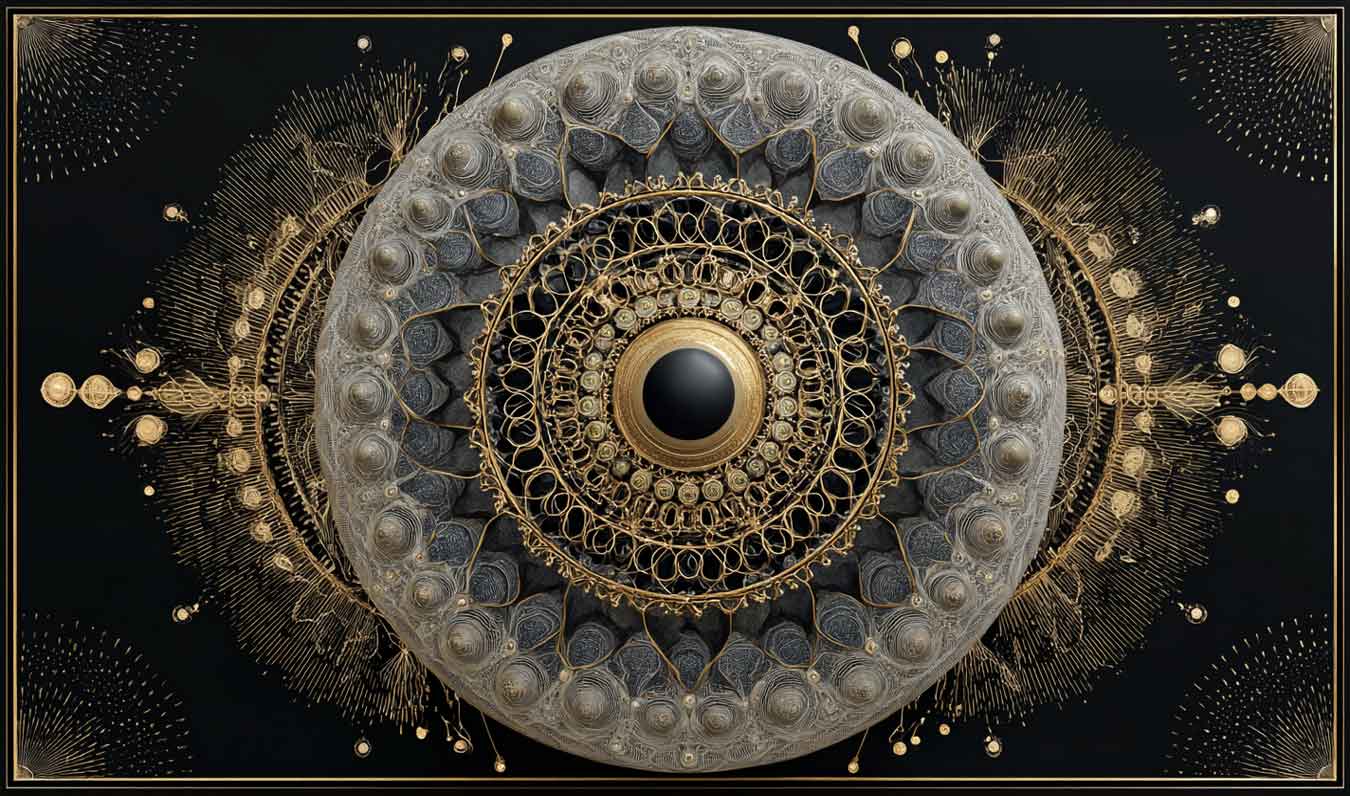
Mandala Machine offers artifacts of remembrance —
visual meditations that restore the psyche to its natural geometry.
This is the workshop where these systems are generated.
Mandala Machine exists as a recalibration.